Overview
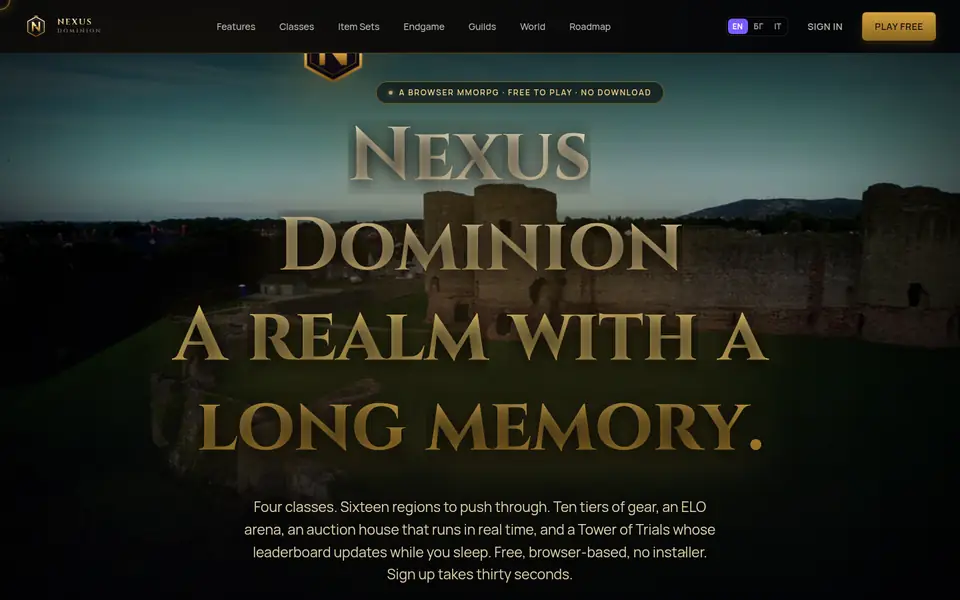
Nexus Dominion is a Massively Multiplayer Online (MMO) game playable straight from the browser, set in a dark-fantasy medieval world. The project started with a precise technical goal: deliver a persistent, real-time gaming experience with hundreds of simultaneous interactions, without asking the player to install anything. Everything lives in the browser, from login to battle. We designed the entire architecture from scratch — from the database to the server-side game engine to the interface.
The Challenge
An MMO is not a website with a few animations: it is a system where the state of the world changes constantly and must stay consistent for every player at the same instant. The main challenge was handling real time — movement, combat, guild chat, the marketplace — while keeping data synchronised and latency low. On top of that sits the complexity of the game domain: dungeons, a PvP arena, guilds and a fully player-driven economy demand a deep data model, with more than 52 interconnected database models and 27 distinct game pages.
The Solution
We built the front end with React and Vite for a responsive interface and fast loads, and a back end in Node.js with TypeScript to keep solid typing over such intricate game logic. Real-time communication runs through Socket.IO, while Redis handles volatile state and high-frequency sessions, taking load off the primary database. Persistence relies on PostgreSQL with Prisma as the ORM: the 52+ models describe characters, guilds, items, dungeons, market orders and battle history. The whole environment is containerised with Docker for repeatable deploys and scalability.
Every game action — an attack in the arena, a bid on the market, a guild message — goes through the same loop: the React client sends the event over Socket.IO, the Node.js server validates it against the current state of the world, and the update is propagated to every player involved. Splitting transient state in Redis from durable persistence in PostgreSQL is what keeps the world responsive even when many events happen in the same instant. TypeScript, applied consistently across front end and back end, cuts down errors in game logic with hundreds of interconnected rules.
Tech Stack
- React
- Vite
- Node.js
- TypeScript
- Prisma
- PostgreSQL
- Redis
- Socket.IO
- Docker
The Result
The result is a complete, playable game platform: real-time multiplayer, a guild system, explorable dungeons, a PvP arena and a marketplace where players set the prices. The 27-page architecture covers the full character lifecycle, from creation through progression to end-game combat. Nexus Dominion proves that with the right stack a complex real-time application can run smoothly and reliably entirely in the browser. You can try it live here: nexus.carbonstealth.eu.
What We Can Do For You
Nexus Dominion is proof that we handle complex real-time applications, not just brochure sites. If you have an idea that needs serious back-end logic, live data or a scalable architecture, we can build it. Explore our custom software development, our web application development and the managed cloud hosting a project like this runs on.